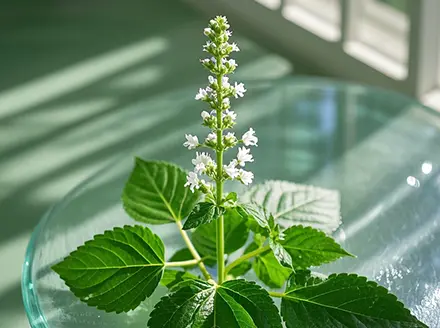
In the rapidly evolving landscape of sustainable chemistry, two diterpenes derived from Clary Sage (Salvia sclarea) have become foundational pillars for premium fragrance and advanced skincare formulations: Sclareol and Sclareolide.
As consumer demand shifts toward clean beauty and eco-friendly manufacturing, understanding the molecular nuances, technical specifications, and supply chain updates of these ingredients is crucial for cosmetic chemists and brand innovators. This comprehensive guide explores the key differences between Sclareol and Sclareolide, highlights the industry-wide transition to modern biosynthetic production, and provides actionable formulation strategies for 2026.
While closely related in their botanical origin, Sclareol and Sclareolide exhibit distinct chemical structures, physical properties, and primary applications.
Sclareol (CAS 515-03-7) is a natural bicyclic diterpene alcohol. It is primarily valued as an indispensable starting material for the synthesis of high-end amber fragrances, most notably Ambroxide (Ambroxan).
Sclareolide (CAS 564-20-5) is a sesquiterpene lactone obtained either via the chemical/microbial oxidation of Sclareol or through direct engineering. Beyond its role in fragrance fixing, Sclareolide has emerged as a powerhouse active in clean beauty skincare due to its proven anti-inflammatory, lipolytic, and hyperpigmentation-regulating properties.
Technical Property | Sclareol | Sclareolide |
CAS Number | 515-03-7 | 564-20-5 |
Chemical Formula | $C_{20}H_{36}O_2$ | $C_{15}H_{22}O_2$ |
Molecular Weight | 308.50 g/mol | 234.34 g/mol |
Physical Appearance | White to pale yellow crystalline powder / amber-like chunks | White crystalline powder |
Odor Profile | Sweet, balsamic, woody with amber undertones | Faint, sweet, woody-balsamic, excellent fixative properties |
Primary Cosmetic Role | Fragrance precursor, key intermediate for Ambroxide synthesis(/products/ambroxide-cas6790585/) | Fragrance fixative, anti-aging active, skin-brightening agent |
Solubility | Soluble in ethanol, oils; insoluble in water | Soluble in organic solvents, hot cosmetic oils |
Traditionally, both compounds were extracted directly from Clary Sage concrete, a process highly dependent on seasonal crop yields, weather volatility, and intensive land use. In 2026, the cosmetics industry has crossed the tipping point toward microbial fermentation, solidifying its position among the top biosynthetic cosmetic ingredients trends 2026.
Unmatched Purity: Engineered microbial strains (such as specialized yeast or E. coli) process glucose into target molecules, eliminating botanical impurities, pesticides, and heavy metal residues. This ensures a batch-to-batch consistency that fits perfectly into high-purity actives for clean beauty standards.
Sustainability and Carbon Reduction: Industrial fermentation drastically reduces water usage, arable land occupation, and carbon emissions compared to traditional agricultural extraction.
Price Stability: Decoupled from agricultural risks, biosynthetic sourcing guarantees a stable commercial supply chain, preventing the price spikes historically associated with natural clary sage crops.
In fine fragrance chemistry, Sclareol serves as the essential precursor to Ambroxide, the molecule responsible for the rich, sensual, animalic warmth of natural Ambergris. Modern master perfumers utilize Sclareol and Sclareolide not just as building blocks, but as superb fixatives that lower the vapor pressure of volatile top notes, extending the longevity of scents on the skin.
Formulation Tip: Pair biosynthetic Sclareolide with alternative sustainable fixatives like Nootkatone to create complex, long-lasting woody and citrus olfactory profiles.
Sclareolide has transitioned from a pure fragrance fixative into a highly functional skincare ingredient:
Melanin Regulation: Clinical studies show Sclareolide can downregulate corporate pathways involved in UV-induced pigmentation, making it an excellent botanical alternative to aggressive skin-bleaching chemicals.
Cellular Energizer: It acts as a soothing agent that down-regulates inflammatory cytokines, protecting the skin barrier from environmental stressors.
Formulation Tip: Integrate Sclareolide into the oil phase ($60^{\circ}\text{C} - 70^{\circ}\text{C}$) of emulsions. For comprehensive anti-aging and barrier-repair formulations, it synergizes exceptionally well with plant-derived Squalane.
Sclareol ($C_{20}H_{36}O_2$) is a diterpene alcohol used primarily as a precursor to synthesize amber fragrance compounds. Sclareolide ($C_{15}H_{22}O_2$) is a sesquiterpene lactone derived from sclareol, utilized directly in cosmetic formulations as a long-lasting fragrance fixative and an active skincare ingredient for skin brightening and soothing.
Biosynthetic Sclareolide produced via microbial fermentation delivers over 98% purity, free from seasonal agricultural fluctuations, pesticide contamination, and botanical adulteration. It complies fully with international clean beauty verification standards and guarantees eco-friendly, carbon-reduced manufacturing.
Yes. When manufactured through modern industrial fermentation utilizing non-GMO plant sugars and microbial cultures, both Sclareol and Sclareolide are 100% bio-based, cruelty-free, and perfectly suited for certified vegan and clean beauty product lines.

 English